Jewelry Recycling
Old jewelry does not have to remain unworn simply because the style no longer suits you. We can redesign inherited, broken, outdated, or unwanted pieces into jewelry that better reflects your taste and the way you live today.
Suitable diamonds and gemstones may be removed and incorporated into a new ring, pendant, bracelet, earrings, or another custom design. Several pieces can also be combined into one project, allowing you to preserve meaningful materials without reproducing the original jewelry.
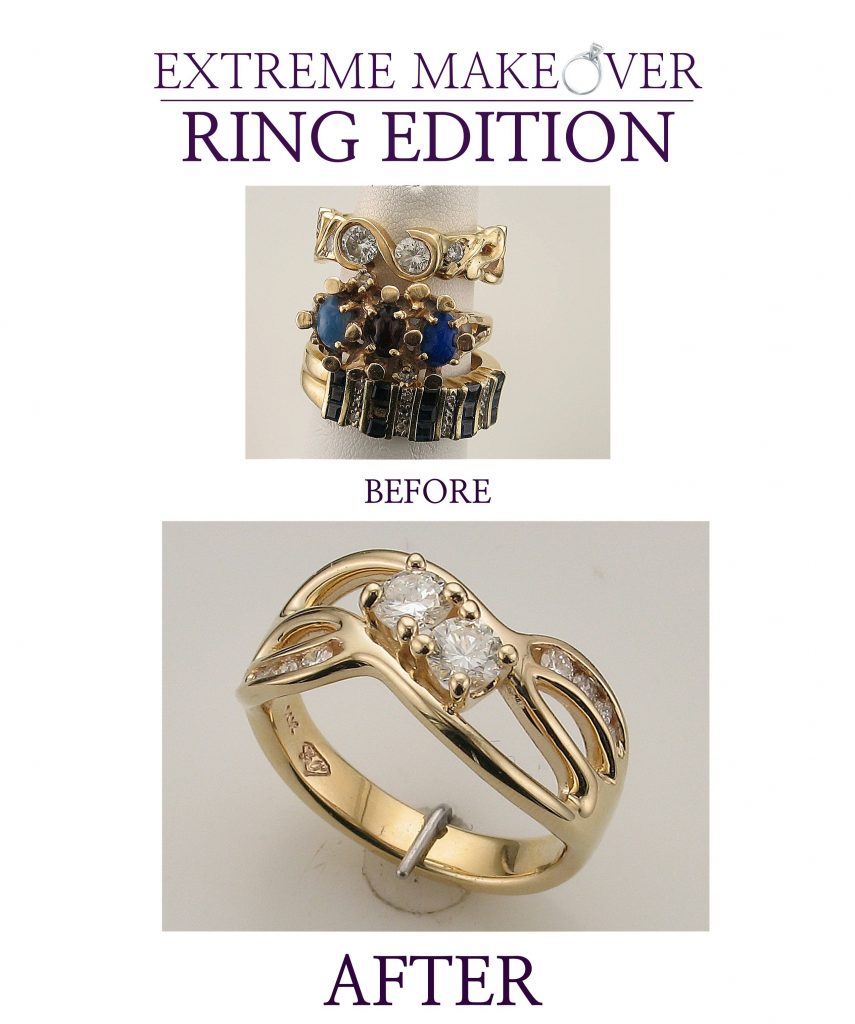
Browse the redesign examples below to see how existing stones and jewelry can become something entirely different. We can use one of these transformations as inspiration or create a new design around the pieces you already own.
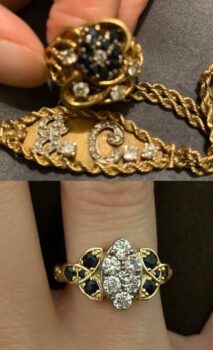
This is just an example of old jewelry that we repurposed into something new, current, and wearable! Not only can the extra materials be put towards the cost of your new ring. But you can also lessen your carbon footprint by using old gold.
Jewelry Recycling Can Preserve Sentimental Value
Jewelry Recycling is a way to keep your loved ones close to you in spirit, even if they are no longer with you. Remaking jewelry inherited from family members can also be incredibly sentimental and rewarding.
Sometimes family members pass down family engagement rings when you’re ready to propose. If you were given an heirloom ring from a family member, but it isn’t your style, repurposing the piece maintains the respect, sentimentality, and meaning of the gift but still allows you to add your style and personality to it
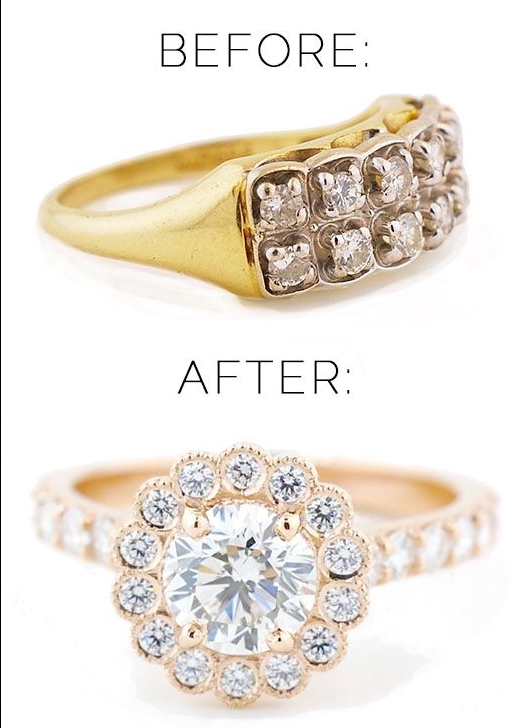 The Halo Ring was made from using the gold and accents from the ring on top combined with a center stone our customer had plus a few new stones. It saved her over $4500.
What Parts of Old Jewelry Can Be Reused?
Diamonds and gemstones are often the most practical parts of an old piece to reuse. Whether a stone is suitable depends on its type, condition, dimensions, shape, durability, and the requirements of the new setting.
Some stones can be removed and reset with very little change. Others may have chips, abrasions, fractures, unusual proportions, or previous repairs that affect how they can be used. The stone must be examined before we can confirm whether it is appropriate for the proposed design.
Existing clasps, chains, findings, and small decorative components are not always suitable for reuse. In most cases, we design the new piece around the materials that remain both useful and structurally sound.
Reusing Diamonds and Gemstones
An existing diamond can become the center stone of a new engagement ring, part of a multi-stone anniversary ring, or the focal point of a pendant. Smaller diamonds may be arranged into a halo, band, cluster, pair of earrings, or another design.
Colored gemstones can also be reused when their condition and durability make them appropriate for the new setting. Sapphires and rubies are generally well suited to many frequently worn designs. Emeralds, opals, pearls, and other more delicate stones may require additional protection and careful handling.
The new design must be created around the exact measurements of the stones. Two diamonds described as the same carat weight can have different dimensions, so we do not design the setting from weight alone.
What Happens to the Old Metal?
The precious metal in old jewelry may have value, but reusing the exact metal is not always as simple as melting it and pouring it into a new design.
Older jewelry may contain solder, mixed alloys, plating, repairs, contamination, or an unknown metal composition. The quantity may also be insufficient for the new piece, particularly when the redesign is wider, heavier, or more detailed than the original.
Depending on the material and project, the old gold, platinum, or silver may be refined, traded for credit, supplemented with new metal, or incorporated when technically appropriate. We will explain the available options after examining the jewelry.
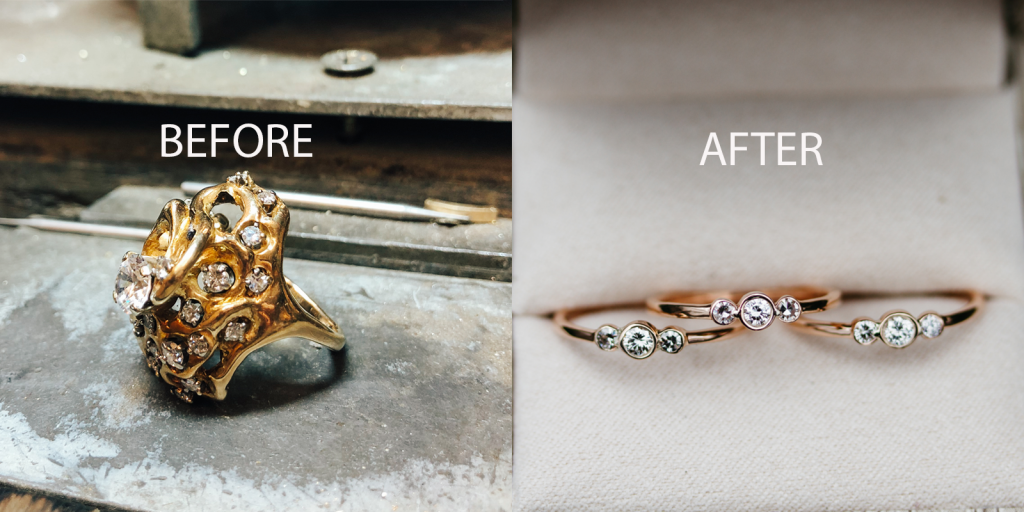
Diamonds removed from four old rings turned into 3 new rings.
Redesigning Inherited Jewelry
Inherited jewelry often carries meaning even when its style, size, or condition makes it difficult to wear. Redesigning it allows you to preserve part of its history without keeping it in its original form.
A family diamond can be placed in a completely new setting. Several small stones from different pieces can be arranged together. A gemstone may be moved from a ring into a pendant if that makes the finished piece more useful or provides better protection.
The redesign does not have to resemble the original jewelry. The connection can remain in the materials rather than the appearance.
Combining Several Pieces Into One
Multiple rings, earrings, pendants, or other items can sometimes be combined into one custom design. This is useful when you have several small diamonds, mismatched stones, or pieces inherited from different relatives.
The stones may be arranged according to size, color, shape, or personal meaning. They do not need to match perfectly, but their differences should be considered intentionally during the design process.
Combining several pieces may also reduce the number of unworn items in a jewelry box while creating one piece you will use regularly.
Engagement-Ring and Wedding-Ring Redesign
An engagement or wedding ring may be redesigned because it is damaged, uncomfortable, outdated, or no longer fits the wearer’s style.
The center diamond can be moved into a new solitaire, halo, three-stone, bezel, cathedral, or vintage-inspired setting. Accent diamonds may be reused along the band or incorporated into a matching wedding ring.
The redesign can also address practical issues. We can change the width, profile, setting height, interior fit, stone protection, or relationship between the engagement ring and wedding band.
Click on the link to learn more about the Mohs Scale.
Stones like Diamonds, Sapphires, and Rubies are very hard and durable. The jewelry remodeling process will probably not damage stones with their hardness. Softer stones like Turquoise, Opal, or Moonstone may not be the best stones to repurpose. When being transferred between settings, they have a much higher chance of being scratched or cracked.
When a Stone May Not Be Suitable for Reuse
Not every gemstone can be safely removed and reset. A stone may have damage that is difficult to see while it remains in the original mounting. Removing it can also reveal chips, fractures, abrasions, or previous repair work.
Very thin stones, heavily included stones, soft gemstones, and stones with exposed points or corners may require special consideration. Some may be suitable only for a protective bezel or pendant rather than another frequently worn ring.
We will discuss the risks before beginning. Although experienced handling reduces the likelihood of damage, no jeweler can guarantee that every old or damaged stone will survive removal and resetting without risk.
How the Custom Redesign Process Works
The process begins with photographs and a description of the jewelry you want to repurpose. Tell us which parts are meaningful, what you hope to reuse, the type of jewelry you want to create, and your approximate budget.
The pieces must then be examined so we can identify the materials, measure the stones, evaluate their condition, and determine what can realistically be incorporated.
Once the design direction and price are agreed upon, a deposit is required to begin the CAD design. We create detailed renderings showing the proposed piece from multiple angles. You can review the proportions, stone placement, and other details before approving it for production.
After approval, the old stones are removed as needed and the new piece is manufactured. It is then polished, finished, engraved when applicable, and set with the approved gemstones. We inspect the completed jewelry and send photographs before shipping.
What Affects the Cost?
The cost depends on the type of jewelry, selected metal, finished dimensions, number of stones, condition of the existing materials, setting requirements, and complexity of the new design.
A simple pendant using one existing diamond will generally require less labor than a ring made with numerous stones of different shapes and sizes. Intricate engraving, pavé, halos, multiple metals, stone repairs, and unusual construction can also increase the cost.
Reusing stones may reduce the amount spent on new gemstones, but it does not eliminate the cost of design, labor, metal, stone removal, manufacturing, setting, and finishing. In some cases, creating the new piece may cost as much as or more than purchasing a standard piece of jewelry.
Give Us A Shot For Jewelry Recycling!
Many people don’t know that it’s possible to create Custom Jewelry using Jewelry Recycling. But with our custom jewelry expertise, it is totally possible. Whether you want to carry on the family legacy or simply switch up your style. The process is personal to you and the possibilities are endless. Do you do have jewelry just sitting around the house not being worn? Consider giving it new life. We would love to create the design you are dreaming of!
Contact us to learn more about our Custom Jewelry or contact us with your idea for Jewelry Recycling. Engagement or wedding rings, pendants, bracelets, and pairs of earrings can all be recycled. It can cost far less to reuse the stuff you have lying around rather than create something from scratch.
You can view our portfolio of custom engagement rings or custom pendants to look for ideas. Or you can contact us with your own idea.
Frequently Asked Questions
Can you melt my old ring and make the new ring from the same gold?
Sometimes, but not in every case. The alloy, solder, repairs, contamination, quantity of metal, and requirements of the new design must first be considered. Refining or applying the metal’s value toward new metal may produce a better result.
Can you reuse very small diamonds?
Often, yes. Small diamonds can be incorporated into bands, halos, clusters, earrings, pendants, and other designs. Their exact sizes, condition, color, and cutting quality will determine how effectively they can be arranged.
Can you use stones from several different pieces?
Yes, when the stones are suitable for reuse. They can be combined even when they are different shapes or sizes, provided the design accounts for those differences.
Can you redesign an inherited engagement ring?
Yes. The center and accent stones may be transferred into a completely new design. The new piece does not have to resemble the original ring.
Will reusing my jewelry make the project inexpensive?
Not necessarily. Reusing valuable stones may reduce the cost of purchasing new gemstones. However, custom design, metal, labor, stone removal, setting, finishing, and other manufacturing work still affect the price.
Can you redesign jewelry from photographs alone?
Photographs are enough for an initial discussion. However, the jewelry must usually be examined before the final design and price can be confirmed.
Do I have to reuse every stone?
No. You may select only the stones that matter most or work best in the new design. Unused materials can be returned, credited, or handled according to the arrangement made before the project begins.
Start Your Jewelry Redesign
Send us photographs of the jewelry you want to repurpose along with a description of what you would like to create. Tell us which materials are important to preserve, what style you prefer, and how you plan to wear the finished piece.
We will help determine what can be reused, explain the practical limitations, and develop the materials into a custom design that is more useful to you than the jewelry in its current form.